Interior fit out approvals in Dubai: the real timeline
Approvals set your handover date far more often than site work does. A Dubai unit moves through a fixed chain: landlord NOC, building permit from the authority that governs the building, Civil Defence, utility and A/C load requests, then inspection and commissioning. Any stage can send the file back.
The approval chain, in the order it actually runs
Start with the landlord, not the authority. No municipality or free zone accepts a submission without the landlord or master developer NOC, and most landlords want the full drawing set, contractor registration and insurance before they issue it. In a managed tower the fit-out guideline decides how that NOC is issued and how your site hours are set.
The building permit comes next. Mainland Dubai means a Dubai Municipality fit out approval. Ports and Dubai World type jurisdictions run through Trakhees. DIFC is the DDA, other free zones are the zone authority. The submission is a drawing set prepared and stamped by a consultant licensed for that authority: layout, ceiling, MEP and fire strategy.
Civil Defence is a separate submission with its own drawings. DCD approval interior fit out covers detection, sprinklers, smoke exhaust, means of escape, signage and fire crew access. A building permit without a DCD file is permission to build a room the building cannot legally occupy.
Utility and load requests follow: DEWA power, meters, A/C capacity, sometimes chilled water. Then third party inspection and testing and commissioning, where installed work is checked against approved drawings before handover and before the landlord returns your deposit.
Who submits what: tenant, contractor, and the documents that stall the file
Tenants hold the documents an authority will not move without: trade licence, tenancy contract registered in Ejari, title deed or developer NOC. If the licence is new or the Ejari was never registered, the file waits.
The contractor carries the technical pack: stamped drawings from the licensed consultant, registration cards, insurance, method statements and site logistics. The landlord NOC for fit out in Dubai is usually issued against that same pack, so one expired insurance certificate can stop two processes at once.
What stalls files most often:
- a trade licence whose activity does not match the use of the unit
- an Ejari certificate for a different unit number
- drawings stamped by a consultant not registered with that authority
- insurance that lapsed between submissions
- landlord approval given verbally
Accountability beats a cheap consultant fee. When the landlord blames the consultant and the consultant blames the contractor, weeks disappear. On our jobs one project manager owns every submission date, and the consultant is picked for registration with that authority first.
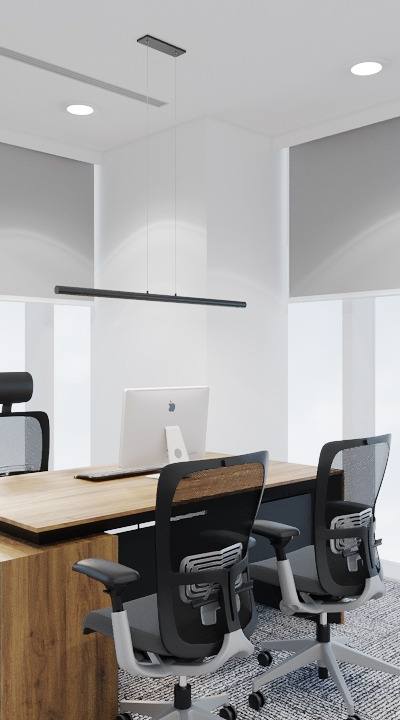
 Black-framed glass partitions like these belong on the approved drawing set, not only in the finishes schedule.
Why fit-out permits get returned
Rejections are rarely about design quality. They are about a submission that does not match something else in the chain.
The sets drift apart. The landlord set, the municipality set and the Civil Defence set must describe the same room. Move a partition between revisions and the sprinkler layout no longer matches the ceiling plan, which is how the partitions in the photo above cause a return when they are drawn as decoration.
Calculations go missing. Smoke exhaust, travel distances and occupancy loads are the sections most often absent, particularly when a meeting room is carved out of an open floor.
Scope changes after the permit. A pantry, a server room or a second meeting room means a revision and sometimes a fresh DCD submission. Settle the layout argument before submission.
The file goes to the wrong authority. A Trakhees building sent to Dubai Municipality, or the reverse, is rejected on receipt.
The revision arrives without the landlord comment. Resubmissions sit until it is there.
Timelines, and where mainland and free zone routes differ
A realistic sequence on a complete first submission: landlord NOC one to three weeks, building permit two to four, DCD one to three running in parallel with the permit, DEWA and A/C load two to four, inspection and commissioning one to two. Those overlap, so a straightforward office can clear the chain in six to eight weeks. Retail and F&B run longer, because extraction and grease bring a heavier DCD review.
Authority queues move with submission volume and no contractor controls that. What a contractor controls is how complete the first submission is and how quickly a resubmission goes back in. That is where lost weeks live, and it is worth asking about when you compare quotes.
Mainland and free zone differ in routing, not in kind. DIFC goes to the DDA. DWTC, DMCC, JAFZA and Dubai South each have their own authority, portal, drawing standards and consultant registration. DCD applies everywhere, so the fire file does not vanish because the unit sits in a free zone. The catch is that free zone authorities keep their own approved consultant lists and inspection sequences, so a consultant who moves fast in a municipality building can be unknown in a JAFZA unit. Ask about registration before appointing anyone. For the site-side sequence there are more interior fit out guides on the blog.
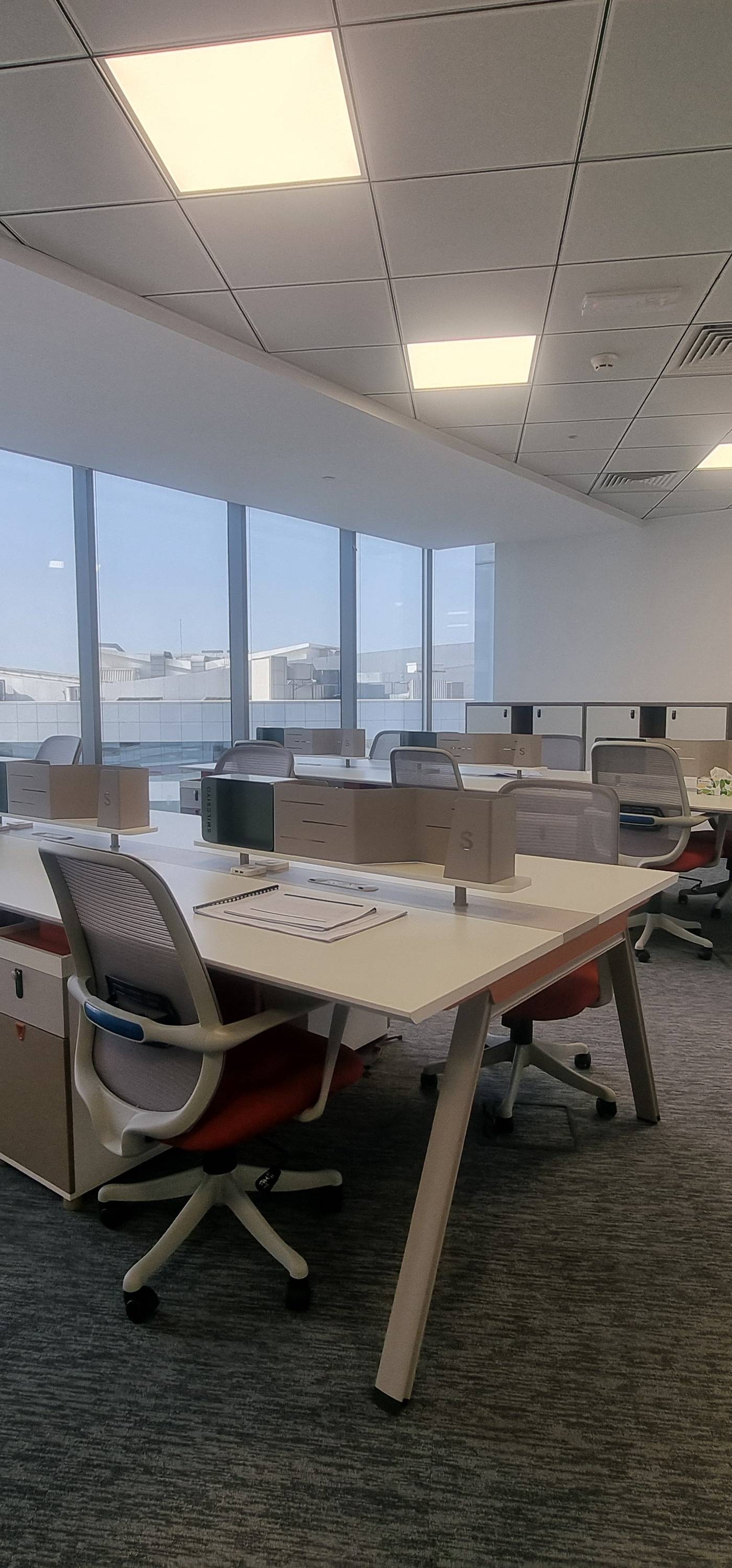 Floor-to-ceiling glazing drives the A/C load request long before the permit is worth submitting.
Before you sign the lease, and what to send us
Five checks before you commit to a unit:
- Existing approvals. Ask for the last approved drawing set and the DCD certificate. A unit with an approved fit out on record is easier to amend than a shell.
- Use category. Office, retail and F&B are different submissions, and some units cannot support a food use at all.
- A/C and power. The glazing in the photo above looks excellent and it loads the cooling system. If existing capacity cannot carry the new occupancy, the load request becomes a project of its own.
- Ceiling and services. Low ceilings, sprinkler positions and duct routes restrict layout more than tenants expect.
- Landlord rules. Fit-out guideline, permitted working hours, deposit, and whether drawings are reviewed in house.
We are an interior fit out contractor in Dubai and we would rather answer these before you sign than after. Send the floor plan with dimensions, photos of the space including the ceiling and existing services, the building name and unit number, the landlord's fit-out guideline if you have one, and your target opening date. That is enough to confirm which authority the unit falls under and what the sequence looks like. WhatsApp is the fastest way to get it reviewed, or talk to our fit-out team about approvals and hand the permit problem over.
Frequently asked questions
How long do fit out approvals take in Dubai?
Roughly six to eight weeks for a straightforward office when the first submission is complete, because the landlord NOC, building permit, DCD and utility requests overlap. Retail, F&B and free zone units usually run longer. Most of the delay comes from incomplete submissions and slow resubmissions, not from authority processing alone.
Do I need a permit to fit out a rented office or retail unit?
Yes. Partitioning, ceiling, MEP or layout changes need a building permit from the authority that governs the building, plus Civil Defence clearance and a landlord NOC. Cosmetic work such as paint and carpet is usually handled under the landlord's own rules, and you should confirm that in writing before starting.
Can I fit out without a landlord NOC?
No. The authority will not accept the submission without it, and the landlord controls site access, working hours and the deposit. The NOC is also where the landlord confirms the unit, the contractor and the insurance. Starting before it is issued puts the whole fit out at risk of a stop notice.
Who is responsible for DCD approval?
The tenant owns the obligation because the DCD certificate attaches to the unit and its use, but the contractor normally manages the submission through a licensed consultant. Drawings, calculations and the inspection sit inside the fit-out scope. Confirm in the contract who pays for resubmissions.
Does a free zone unit need Dubai Municipality approval?
Generally no. Free zone units route through their own authority, such as the DDA in DIFC or the zone authority in JAFZA and Dubai South. Civil Defence still applies, and DEWA or the zone utility provider still handles power and load requests. Submission standards differ, so use a consultant registered with that authority.