How to choose an interior fit out contractor in Dubai
Choosing an interior fit out contractor in Dubai comes down to three things: a written scope with an itemised bill of quantities, verifiable licensing for permits and approvals, and a dated programme you can hold someone to. Price matters, but it is the last thing to compare, not the first.
Why work with INTERIOXPERT TECHNICAL SERVICES CO. L.L.C
- Commercial fit out only, covering offices, clinics, retail and food and beverage units
- In house technical trades for MEP, partitions, ceilings, joinery, flooring and painting
- Itemised bill of quantities issued with every interior fit out quotation in Dubai
- Permits and approvals coordinated with Dubai DET, Dubai Civil Defence and DEWA
- One named project contact from site visit through to snagging closeout
- Direct WhatsApp line on +971 58 510 1641 to book a site visit
Why the contractor choice decides your budget and handover date
A contractor decides your final number and your handover date far more than your design does. Drawings rarely change beyond small percentages. What moves is how variations are priced, how trades are sequenced, and how fast approvals are filed.
Roughly four fifths of a Dubai fit out budget sits in labour, materials and project management. A contractor who sub-contracts every trade carries a margin on each one, and each trade waits its turn. A contractor with in house MEP and joinery keeps the ceiling void, the ducting and the electrical containment on one programme, which is usually where the weeks are won or lost.
Delay is the expensive part. On a 12,000 sq ft office under a five year lease, a four week slip on handover can leave you paying rent on space you cannot occupy. That cost is almost always larger than the gap between a cheap quote and a properly priced one.
Scope: full turnkey versus single trade
Full turnkey means one contract covers design coordination, permits, MEP, partitions, ceilings, joinery, flooring, painting and snagging. Single trade means you appoint each separately and own every interface between them.
| Item | Turnkey contract | Single trade contracts |
|---|---|---|
| Contracts to manage | One | Five or more |
| Programme responsibility | Contractor | You |
| Variation pricing | Agreed unit rates | Re-quoted each time |
| Permit and approval owner | Contractor | Often unassigned |
| Snagging closeout | One defects list | Split between trades |
| Suits | Offices, clinics and F&B on one handover date | Small single room works |
Most commercial clients in Dubai are better served by turnkey interior fit out services, because the interfaces between MEP and ceilings are where cost and time leak. If you only need a carpet change or one partition, a single trade contractor is fine.
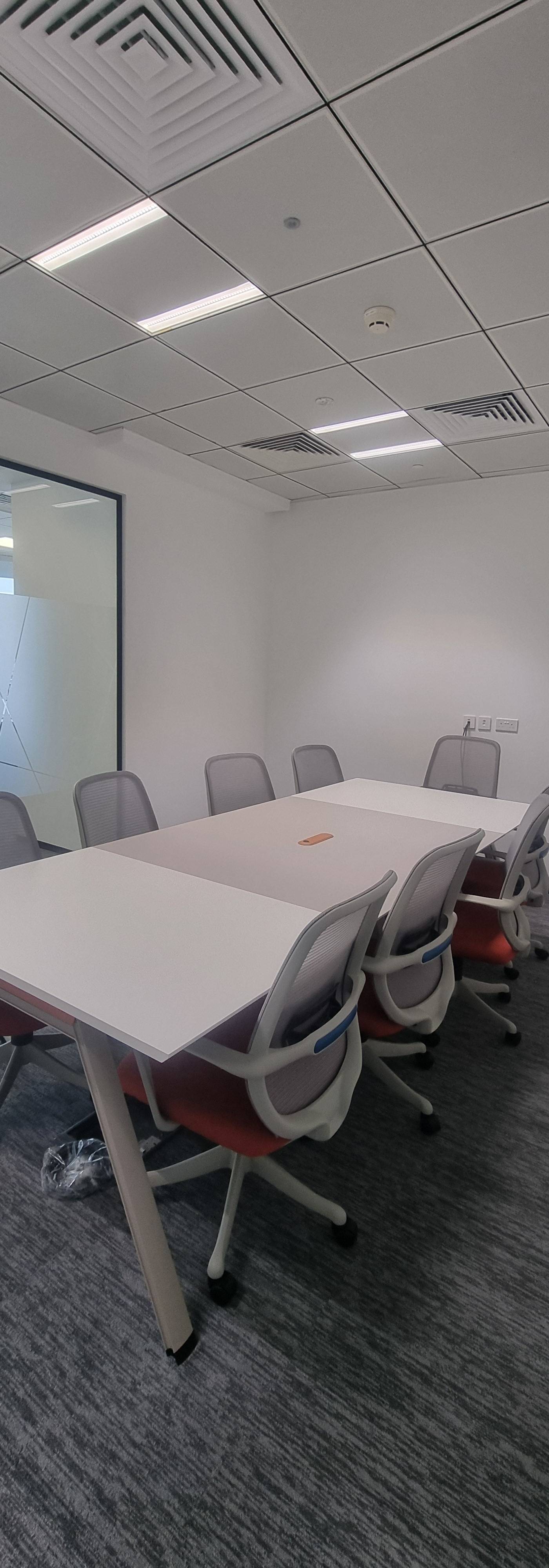 Meeting rooms force the ceiling void, ducting runs and partition acoustic rating to line up in one place.
Licence, credential and permit checks before you sign
Three checks take twenty minutes and eliminate most of the risk before you shortlist an interior fit out company in Dubai. Ask for the trade licence, ask who owns the permits, and ask for insurance certificates.
- Trade licence from Dubai DET with a fit out, contracting or technical services activity, not general trading. Note the number and the expiry date.
- Public liability and workmen's compensation insurance, current, with the certificate dated in the last twelve months.
- A named site manager and a named project manager for your job, with contact details written into the contract.
- Written confirmation of who files the fit out permit, the Dubai Civil Defence fire and life safety submission and the DEWA load application.
- Two references from comparable commercial projects, ideally still occupied by the same tenant.
Permits are the part clients underestimate. A commercial unit needs an authority approved fit out permit, a Civil Defence submission covering fire alarm, escape routes and suppression, and a DEWA application if the connected load changes. If a candidate cannot describe that sequence in order, the project will stall with finished walls and no occupancy approval.
What a proper interior fit out quotation in Dubai should itemise
A fit out quotation should be a bill of quantities with quantities, unit rates, totals and a payment schedule. A single lump sum figure is not a quotation.
Every line below should appear, or be explicitly excluded in writing:
- MEP: HVAC ducting and FCU modifications, controls, electrical containment and distribution board, small power, data, plumbing, drainage, fire alarm and sprinkler adjustments
- Partitions: drywall, glazed and demountable systems, acoustic rating, doors and ironmongery
- Ceilings: grid, gypsum, bulkheads, access panels and light fittings
- Joinery: reception desk, pantry, storage, meeting room partitions, laminate or veneer finishes
- Flooring: screed and levelling, carpet tile, LVT or porcelain
- Painting and finishes: surface preparation, number of coats, feature walls
- Snagging and handover: snag list, as-built drawings, O&M manuals, warranty certificates
- Provisional sums, exclusions and the unit rates that will apply to variations
A worked example. A 12,000 sq ft office fit out at mid specification in Dubai generally lands between AED 180 and AED 250 per sq ft in 2026, which is roughly AED 2.16 million to AED 3 million. Inside that, expect MEP at 25 to 30 percent, partitions and ceilings at 25 to 30 percent, joinery at 15 to 20 percent, flooring at 8 to 10 percent and painting at 4 to 6 percent, with the balance covering permits, project management, snagging and contingency. If a quote arrives at AED 120 per sq ft, ask what was removed. It is usually ducting modifications, fire alarm coverage or the joinery scope.
Site visit, programme and who owns the approvals
Insist on a site visit before any number is issued, then get the programme in writing with names and dates attached. A quote produced without measuring the unit is an estimate dressed up as a contract price.
- Site visit with the contractor's own site manager, not a salesperson. Measure the unit, check the ceiling void depth, the existing FCU capacity, available power and loading bay access.
- Scope review. Walk the drawings against the unit and get every exclusion confirmed in writing.
- Permits. Confirm who files the fit out permit, the Civil Defence drawing approval and the DEWA load application, and put each one in the programme as a dated milestone.
- Programme. Get a bar chart with milestones for mobilisation, MEP first fix, ceiling closure, joinery installation, painting, MEP second fix, snagging and handover.
- Reporting. Weekly written progress report with photographs, a percentage complete figure and a variation log.
- Delay. Agree liquidated damages or a milestone based retention before signing.
- Handover. Snag list, as-built drawings, O&M manuals and warranty certificates, delivered as one package.
These are the questions to ask a fit out contractor in Dubai before you compare prices: who runs the site day to day, how often do I get a written report, what happens if the Civil Defence approval is delayed, are delay penalties in the contract, who pays the authority fees, and what is the retention percentage.
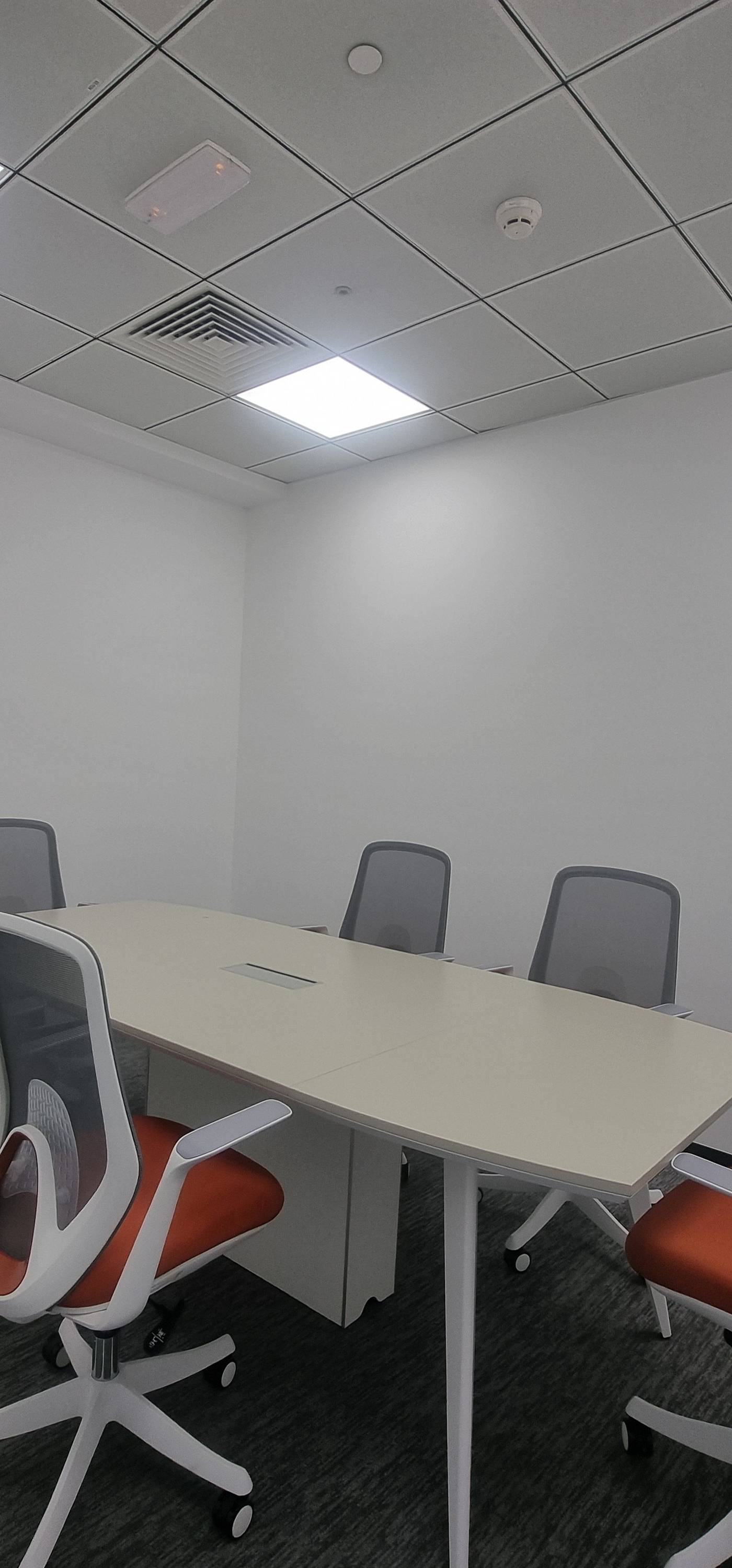 Six seat meeting rooms are priced per room, because lighting, AV routing and joinery are fixed quantities.
Snagging, warranty and the red flags to walk away from
Standard practice in Dubai is a 12 month defects liability period from handover, with the snag list closed within 14 to 30 days. A retention of 5 to 10 percent is normal and is released once the snag list is signed off.
Warranty periods differ by element. Workmanship is typically 12 months. MEP equipment follows the manufacturer, usually 12 to 24 months. Joinery and finishes are usually 12 months. Get all three in writing, with the start date defined as handover rather than practical completion.
Red flags during fit out contractor selection in Dubai
- No written BOQ, only a lump sum figure sent by message
- Cash only terms with no contract, no tax invoice and no payment schedule
- A programme that says eight weeks without dates, milestones or a named site manager
- No references from comparable commercial projects
- A large deposit demanded before any permit is filed
- Refusal to list exclusions or variation rates in writing
If these show up, the cheapest quote will not stay the cheapest. Read more interior fit out guides for Dubai, or request a fit out site visit in Dubai and get scope, programme and BOQ in writing first.
Frequently asked questions
How much does a commercial interior fit out cost in Dubai?
A mid specification turnkey office fit out in Dubai generally costs between AED 180 and AED 250 per sq ft in 2026. A 12,000 sq ft office therefore lands around AED 2.16 million to AED 3 million. Heavy MEP changes, specialist finishes or shell and core conditions can push rates above AED 350 per sq ft.
How long does an office fit out take in Dubai?
Allow 3 to 6 weeks for permits and authority approvals before site works start. On site, a 5,000 to 15,000 sq ft office typically takes 8 to 16 weeks, depending on MEP scope and joinery lead times. Add around two weeks for snagging closeout before you move furniture in.
What questions should I ask a fit out contractor in Dubai?
Ask who will run the site daily, how often you receive written progress reports, whether delay penalties sit in the contract, who files the fit out permit and the Civil Defence submission, what the retention and defects liability period are, and which items are excluded from the price. Get the answers written into the contract, not sent as a message.
Who is responsible for the fit out permit and Civil Defence approval?
Under a turnkey contract the fit out contractor normally files the fit out permit, the Civil Defence fire and life safety submission and any DEWA load application on your behalf. Confirm this in writing before signing, and ask who carries the cost of authority fees. If approval delays are not the contractor's responsibility, the programme has no teeth.
What is a defects liability period in a Dubai fit out?
It is the period after handover during which the contractor must fix defects at no cost to you. Twelve months from handover is standard for commercial fit out in Dubai, covering workmanship, joinery and finishes, while MEP equipment follows manufacturer warranty terms of 12 to 24 months. A retention of 5 to 10 percent is normally held until the snag list is closed.
Do I need a DET licensed contractor for a fit out in Dubai?
Yes. The contractor should hold a Dubai DET trade licence with a fit out, contracting or technical services activity, and must be able to show current insurance. Units inside free zones also need the free zone authority NOC, and the fit out permit is issued through that authority rather than DET.